
M/S ENDEAVOUR: BEYOND THE CONVERGENCE TO GOUGH ISLAND AND TRISTAN da CUNHA
By J. Brock (SARTMA)
Grytviken, at 54 degrees and 15 minutes south and 37 degrees west, quickly faded into the distance as we made good progress through the icebergs and growlers that dotted the Southern Ocean below the Antarctic Convergence. Indeed, it took two days sailing at 12 to 13 KTS to cross that point and sail north-easterly towards Gough Island. That fine trailing wind that ENDEAVOUR experienced on the way to South Georgia was still there but because of our change in direction, the ship began to rock from side to side. There would be two days of this, until we passed the Convergence.
South Georgia lectures continued, with excellent footage shot by David Cothran, a dive specialist. Many of the species I saw in the Aquarium at the Cook Labs on King Edward Point were shown in their natural habitat. This lecture and film was followed by several in the following days by Tom Richie on marine biology and Jim Kelley on the circulation of the world’s oceans.
Much of my time between Islands was taken up with transcribing interviews and sorting out photos taken in South Georgia. It was an enjoyable experience, even though the ship was rocking. Thankfully, there was no pitching –that and cork screwing cause much sea-sickness, even when one takes to their bunk. As things stood, I couldn’t leave my laptop unattended and when I left for meals, it had to be stowed away. Nonetheless, the bulk of the work was done by the time, early on Tuesday, 11 March, when ENDEAVOUR crossed over the Antarctic Convergence and away from the danger of so many icebergs.
We still had three days in which to reach Gough Island. There, we hoped to bunker with the EDINBURGH, a Company mother-ship from South Africa that did fishery Patrol work for Tristan da Cunha. Unfortunately, this didn’t work because the hoses on the EDINBURGH were too short and the sea was too rough, which made it dangerous for the two ships to be tethered together.
I had seen refuelling at sea before, on a sea day with the Royal Naval Association, between RFA GREY ROVER and a Naval Frigate. Both ships sailed parallel to each other at the same speed and the hose was high-lined from GREY ROVER to the Frigate, attached, fuel transferred and the process reversed to retrieve the hose.
The bunkering problem with bunkering arose because Ascension Island’s MERSK, had been withdrawn and the ENDEAVOUR couldn’t refuel until she reached Cape Verde. There was plenty of fuel for that, but it would have been more reassuring for the crew if there were bunkers before then. Fortunately, Ascension Island Councillors are solving the problem and there will be more on that solution later.
A heavy swell greeted ENDEAVOUR when she arrived at Gough Island, located at 40degrees and 20 minutes south and 10 degrees west. Fortunately, conditions did not deter us from taking a zodiac tour of the island. We were not allowed to land. From others who did land, like Ian Orr, Team Leader of the Biodiversity Team from the Environment Policy Department (Foreign and Commonwealth Office) and James Glass from Tristan da Cunha, I learned of some of the issues that face the island. One was the eradication of certain introduced plant species – reported to be successful.
The other was an unfortunate accident that happened in the waters close to Gough Island a few years ago when two fishermen lost their lives. One group of two was lowered from the EDINBURGH into the water in order to do a net inspection. A sudden squall caused the dinghy to overturn with the loss of one life and the other person making their way to shore on Gough Island. Another dinghy was sent out to rescue the man on shore and it also overturned with the loss of one life, with two other crew-members making it ashore on Gough Island. It took three days for SAS PROTEA from the South African Navy to come and rescue them.
Recent Gough Island landings were made by the former St. Helena Governor, Mr. David Smallman, as well as various teams of environmentalists, lead by James Glass. There is a three-man weather station at Transvaal Bay, servicing the region and its shipping with forecasts. Gough Island is a world heritage site with a management plan to protect the island. With its fragile ecology, remoteness, rough terrain and no guides, it wasn’t safe or practical to allow 53 tourists ashore.
Nonetheless, Dr. Jim Kelley carefully manoeuvred our zodiac through the kelp beds and close to shore to see Fur Seals and Penguins in abundance. Unlike South Georgia, the island had indigenous trees and it was lush and green. With approximately 100 inches of rain a year, there were many waterfalls – some of them running backwards up the steep cliff faces. Dr. Kelly even guided us beneath a rock bridge to see more seabirds and to look at the only landing spot on the island.
On the way back to ENDEAVOUR, I actually felt the warmth of the sun on my face and it was an indication that Tristan, Felicity, James, Sandra, Ian and all awaited. As I came aboard, the Chef was fishing for yellow-tail off the sun deck. We enjoyed them for lunch as we made our way north towards Tristan da Cunha.
A Tristan expert – I am not! Prior to my arrival on ENDEAVOUR at Quest Bay, all I knew of Tristan was that some people I really cared about lived there. Yes. The computer equipment I brought with me would help them to communicate without the outside world and I am sure that Roma’s mail and packages would be appreciated. Ditto for the packet of papers I brought from the Falklands Fisheries Department. James Glass came aboard with a Policeman, Policewoman, and a Customs Officer. His team managed to process the passports and, after signing an indemnity form, we were allowed ashore.
The long awaited lobster lunch at the Glass family home was on the cards for me, as well as a fisheries interview with James. We chatted in the lounge until it was time for us to get onto the Zodiacs. That’s when things went pare-shaped. Brian Baldwin told me once that the chances of actually getting ashore were 60/40. My lot was with the 40% that couldn’t. We were waiting our turn when one of the Zodiacs tipped in the heavy swell and several occupants were thrown into the sea. Conrad, the Harbourmaster, jumped into the sea to help rescue them. Once on shore, they were given blankets and taken to the hospital for the once-over. It was decided then, with James and his team, still aboard the ENDEAVOUR, to close the harbour and to get the Tristanians and freight off – somehow. Another chance to go ashore would open up on Sunday.
Meanwhile, one of the last Zodiacs of the day, piloted by Dr. Paul Carey, carefully made its way into the small harbour with the equipment and mail I had so carefully packed prior to my departure. For me, though I didn’t make it ashore on that day, it was "mission accomplished" as I had planned for well over a year to help replace some of the equipment that was damaged in the hurricane that Tristan suffered on 21 May 2001. Two computers and software arrived via the RMS ST. HELENA in January and I had the monitors, digital cameras, more software scanner, printer – you name it. From the time I read James’ report about the damage the hurricane did, until now, I had been working to help replace some of the computers. They were ashore and I could rest easy.
On Sunday, I was determined to be on the first zodiac to go ashore but try as I might, the best I could do was the second zodiac. The sea conditions were fickle with it being like a millpond one minute and heavy swell the next. When the Officials, who had been in Church, were ready to let ENDEAVOUR begin to ferry passengers ashore, conditions seemed to be OK but the decision was made to put only 5 or 6 people in each zodiac. That’s what scuppered the last chance I had for getting ashore. Dr. Gary James was at the rudder and we got off all right with 5 aboard but a decision was made to call us back for another passenger. My heart sank. By the time we had picked up the passenger and were at the mouth of the harbour, two huge waves crashed on to the jacks and the second one nearly killed Conrad. I saw him lose his balance, his grip and hit his head. The harbour was closed.
Those who reached shore were told to come back and we made our way to ENDEAVOUR. Once aboard, we set sail. The Tristanian Guides would not be coming and we were not allowed ashore on Nightingale Island. Yes. It was harsh but the decision to close the harbour was the right one. It brought home to me the great need Tristan has for a proper jetty and harbour complex. In the past, HMS ENDURANCE had brought a team of Royal Engineers to the Island to set explosives and blow away some of the rock at Quest Bay where the pre 1961 jetty was. That project was successful with several tonnes of rock being blasted away and removed. Tristanians are determined to pay for it themselves and do the work. However, the 2001 hurricane put things back considerably. Without the new jetty and harbour complex, my experience will be enacted again and again and again by many people who hope and dream of getting ashore on Tristan. One person had tried for seven years and each time the sea conditions would not permit that all-important walk ashore. "Even if it’s in a small way," I thought, "I’ll try and help with the project, not only for myself, but also for that person and many others as well."
Combinations of bright and hazy sunshine made picture-taking conditions excellent and Nightingale Island did not disappoint. Though we could not go ashore, there was lots of wildlife to photograph as well as spectacular scenery. Midway around the lee of the Island, we were greeted by a zodiac from the ship carrying a little something to cheer us up. Picture snapping became much easier after that. In all, we spent over an hour looking at the shacks that Tristanians had built on the island, along with the wildlife. Penguins made their rookery near to shacks that hadn’t been repaired since the hurricane.
Tristanians use Nightingale Island as a holiday spot and they go there to collect penguin eggs, and to fish, etc. That Island was populated for a brief time just after the 1961 eruption on Tristan. Longboats were used to transport them and their luggage prior to their rescue. Since the 2001 hurricane most of the shacks had been repaired but there are a few still in a bad way.
In the late afternoon we sailed back towards Tristan and I was able to raise Ian Lavarello, Tristan’s Head of Posts and Telecommunications, on the HF Radio to arrange a schedule with James. We would conduct the fisheries interview via radio on Monday morning.
The pictures show:
Yellow Nosed Albatross on their Gough Island Nests
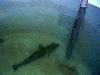
A Toothfish in the Cook Labs Aquarium
Edinburgh from above, showing the harbour. The jetty can’t be longer because of the sheer drop off close in to shore.
Edinburgh as I saw it from the ship
Dunked: Those in the boat that tipped and threw some into the water. Pictured in no particular order are: Tom Richie, Tim Severin, Mims Aultman, Sally Champion, Tony Hart, Dwayne Sundell, Tsukasa Horie and Nancy Horie.
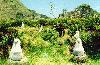
Shacks used by Tristanians on Nightingale Island. Penguins are taking over those that are not repaired.
Tristan in the afternoon. As the Island warms up, it makes its own weather.