M/S ENDEAVOUR: DÉJÀ VU WITH FRIENDS AND FAMILIAR PLACES
By J. Brock (SARTMA)
Godthall Bay emerged from the mist and greeted us travellers on the morning of March 9th. It was a typically grey day with a spot of drizzle and a 0600 wake-up call for a 0630 Zodiac tour. I took the chance for more photos and boarded a Zodiac piloted by Dr. James Kelly, who pointed out the bay’s abundant wildlife. Fur Seals slithered by us in a fantastic display of playful swimming and there were at least two species of penguins. Seabirds were also in abundance as we made our way around the bay and Reindeer could be seen along their well- travelled tracks.
They were a reminder of the fantastic Gurkha Reindeer Curry that I had 17 years ago in Husvic at the Safe House. The menu was complemented with "Compo," or what is better known as field rations. Bernard Reiker, Peter Whitty, Jill Doyle, June MacMullan and I had taken Reindeer tracks from Stormness to Husvic on a brilliantly sunny day. At the same time, a Gurkha patrol, complete with freshly killed Reindeer, made camp at the Safe House that was close to the shoreline at Husvic. We arrived while they were preparing lunch and couldn’t say no when offered a taste of real Gurkha cooking.
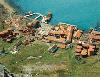
This was my first visit to the derelict whaling station at Godthall Bay but it was a case of you can look but you cannot touch. We were confined to the Zodiac because entering whaling stations if forbidden. They are in a state of decay and too dangerous to enter. Pieces of houses and sheds flapped in the wind and it wouldn’t be long before the rotten wood came crashing to the ground.
M/S ENDEAVOUR made the short distance to the anchorage in Cumberland Bay while we were eating breakfast. I was famished, but like a little kiddie travelling on holiday, I watched the shoreline for the familiar pattern of mountains that meant Grytviken was not far away. The rest of the travellers would go to Shackleton’s Grave and have a tot of rum in his memory, and I would take a Zodiac to King Edward Point with Patrick Lurcock and the much-awaited interview. Others were getting ready for their morning tipple. On went the stiff water-proof trousers, heavy coats, gloves and wooly hats. With efficient precision the Zodiacs were loaded with people who had, by virtue of all that extra clothing, become twice their normal size.
South Georgia’s Pooh-Bah, Patrick Lurcock, arrived as the Customs Officer to "affix" that all-important stamp in each passport. When the formalities were over, Patrick and I took the short journey to his warm office in the Fisheries Department. I had known Patrick and his wife, Sarah, when he was working as a fisheries scientist in the Falkland Islands. Sarah had taken a job in the local radio station, where I met her. They had just been married and were beginning life together in one of the remotest areas of the world. Both took to South Georgia, even remoter, and have literally become part of the place.
King Edward Point, KEP as it is known to South Georgia hands, had drastically changed since my arrival 17 years ago. Landing then was a risky affair on a sea-truck, a rickety jetty and a contingent of 22 Gurkha Rifles. Since the last visit, Discovery House had burnt down as a result of a faulty (careless, really) home-built sauna, and Shackleton House, that shook so hard in the wind that one needed sea sick pills to prevent motion sickness, were gone. The later was taken down after the Cook Labs were built and officially opened. The old jetty was gone, and so was the old post office. Accommodation, scientific laboratories and fisheries, are incorporated in the Cook Labs and Everson House. There is a new boathouse for the local fisheries vessel and everything is neat and tidy. To be fair, 1986 was only four years after the conflict and there were many temporary fixes to the facility’s infrastructure. That DIY look had vanished.
Both Patrick and Chief BAS Scientist, Katherine Ross gave me a tour of the new facility, which, in the words of Katherine, is state of the art and has a fantastic view. The Fisheries Department has offices in the building that also boasts comfortable accommodation. The Cook Labs have an aquarium, wet and dry labs, and ample storage space for scientific samples. The facility also houses the Post Office, where Sarah Lurcock is now Post-Mistress.
Sarah also is responsible for checking air quality in Grytviken with a sophisticated air monitor, which she takes to the derelict whaling station every two days. This is a precaution due to the lingering affects of asbestos, which was widely used in the construction of the factory and accommodation.
A team of specialists from AWG Falklands Limited would be coming in the next week to assess the work and process needed to remove the asbestos. When later asked about the work, the Assistant Commissioner, Russ Jarvis, said that the work should be completed over one, possibly two summers. It was an expensive measure but had to be done to protect the people living there and to reassure those who visit on cruise ships that the place is safe. He added that along with the clearance either parts or all of the station at Grytviken would be dismantled and removed.
The other whaling stations would be closed for all visitors. And, the plan is to let them gently rust and blow away. If someone can raise money, it is possible that the Manager’s Villa at Stormness could be saved. It would be an expensive venture and, aside from some restorative work ten years ago and the erecting of a plaque, nothing much had been done to the structure. I had seen for myself, in 1986, the damage both weather and the odd vandal had done to the building. It was a sorry chapter for such a historic structure.
After the interview (posted on FINN and SARTMA) I took the short Zodiac ride with Dr. Gary James, to Grytviken and visited the museum, where I saw rooms of exhibits and historical photographs. I remember the late Nigel Bonner, who helped to found the museum, explaining the collection and his work with displaying of the photographs. At last, I could see the display and marvel over how much South Georgia had changed from the early days when the whaling stations were in full swing. The building originally was the C. A. Larsen Management Villa and had been painstakingly renovated almost single-handedly by Bob Kluzniak, who spent several summer seasons on the Island while completing the work.
Tim and Pauline Carr were in the shop when I arrived. It was good to have a long-ish chat and persuade them to have their photo taken. Both had also come to South Georgia from the Falklands about ten years ago. Tim had restored the Whalebone Arch, which, along with the Cathedral, symbolises the Falklands. They had arrived in South Georgia aboard their yacht, CURLEW, which at that time, was nearly 100 years old. Their book, "Antarctic Oasis," described their arrival and life on South Georgia, as well as vivid descriptions of the physical and natural aspects of the Island. I had spent much of the morning on KEP, so it was soon time to return to ENDEAVOUR, where Tim, Pauline, Pat, Sarah, Katherine and several others from KEP would be having lunch.
Lunch-time conversation centred around the increasing population of Fur Seals. Sarah reckons they will increase in population, then will go into decline as a result of possibly an illness. Indeed, in the Northern Hemisphere, similar occurrences have already taken place. While it is sad to see, it is a natural cycle and enough strong ones will be left to, re-populate the shoreline in abundance. It was déjà vu for an hour and a half and then, so long until next time. We sailed past the new facilities on KEP and out of Cumberland Bay on our way north to Gough Island and Tristan da Cunha.
Photos (c) J. Brock (FINN) Lyle Craigie-Halkett, and Stuart Broughton
The pictures show dereliction in the whaling stations, Guisers that occur rarely when ice builds up at Gull Pond, The Whalers' Church, King Edward Point as it is today, Patagonian Toothfish, Tim Carr working on the Whalebone Arch in 1991, Bob Kluzniak, who did most of the building work and restoration on the C.A. Larsen Villa and Tim, Sue, and Pauline in the Museum Shop.